Local Government, Housing and Planning Committee
Report tracking the work of the Local Government, Housing and Planning Committee 2024-25
Membership changes during the reporting period
Since we last published a tracker report on 15 November 2024, the following membership changes have taken place on the Committee:
On 19 June, Evelyn Tweed MSP replaced Emma Roddick MSP as a member of the Committee.
Introduction
At its meeting on 14 June 2022, the Committee agreed that it would produce a report annually reflecting on its work in the preceding year, tracking ongoing work, the Scottish Government’s response to that work and looking ahead to work in the coming year.
The Committee believes that a critical feature of an effective committee is a commitment to follow-up on inquiries and ensure that recommendations have been acted upon and progress made. This report is a key element of this follow-up work, allowing the Committee to track its work and in turn hold the Scottish Government to account.
This report reflects on the work of the Local Government, Housing and Planning Committee in the fourth year of Session 6 and looks ahead to the Committee’s work in the final months of the session. In particular, the report considers the extent to which the Committee's work explored in previous reports has been progressed.
Committee's guiding principles and objective
The Committee believes that it can be most effective by focusing on a select number of issues and pursuing them throughout the session. The Committee considers that this is a more effective approach than the Committee moving from one issue to another without having the opportunity to re-visit work and assess progress.
It gives the Committee the opportunity to ensure that the Scottish Government is responding to its recommendations in a meaningful way.
The Committee is keen to ensure that the issues it does pursue are reflective of the concerns of its stakeholders and the wider community and works with stakeholders and communities to:
identify priorities;
develop and undertake inquiries; and
track recommendations arising from those inquiries.
The Committee is also keen to improve public understanding of local government, housing and planning and to demystify them, in order to enable people to better engage with those services and in turn improve people's experience of them.
Reflections on the fourth year of the session
This report is not intended to be a definitive account of everything done by the Committee, but rather a summary of the key issues explored by the Committee over the course of this session and the progress made in relation to these issues over the last year.
The Committee's first report, reflecting on 2021-22, formed the baseline against which this and all other reports are measured.
The report is split into three sections, focusing in turn on the Committee's work in relation to local government, then housing and finally planning. In the case of each item under these headings there is an indication of whether no progress has been made, some progress has been made or good progress has been made.
Local government issues
New deal - Verity House Agreement
The Verity House Agreement (VHA)i was published on 30 June 2023. This committed to various forms of collaboration between local government and the Scottish Government including:
Development of a Fiscal Framework (September 2023) and joint evaluation of the first year of operation (August 2024);
Agreement of a monitoring and accountability framework; and
To “work together strategically to advance public service reform”.
Fiscal Framework
The VHA states:
"Through the development of a robust Fiscal Framework, which will include meaningful early budget engagement, the Local Government Settlement will be simplified and consolidated, clear routes to explore local revenue raising and sources of funding will be established, and wherever possible multi-year certainty will be provided to support strategic planning and investment."i
The Fiscal Framework developed between COSLA and the Scottish Government formed the basis of discussions between the two in advance of the Budget for 2025-26, despite not having been published. The Committee questioned this and in May 2025, the Cabinet Secretary for Finance and Local Government wrote:
"It is regrettable that we have yet to agree a document which codifies the actions we are taking into a published ‘fiscal framework’. Despite COSLA Leaders openly welcoming the progress made during 2025-26 in their response to the Scottish Budget, some Leaders wish to see further work to explore a rules-based funding arrangement."ii
The Cabinet Secretary explained work had been done to explore this but, having "...identified unacceptable financial and operational risks both to Scottish Government and to Local Authorities", Scottish Government support for this work concluded in favour of applying resource to other budgetary matters.ii
She also noted that COSLA thought a Fiscal Framework could not be concluded until they had completed further work on a rules-based funding arrangement.
In October 2025, the Committee received correspondence from the Cabinet Secretary and COSLA Resources spokesperson, Councillor Katie Hagmann, confirming the publication of the Fiscal Framework.iv
The Framework does not describe how its operation will be monitored or evaluated.
In evidence to us, Councillor Hagmann said the Cabinet Secretary had "...assured us that it will be reviewed. It is a joint venture, and there is a commitment to review it regularly."v
She expressed disappointment it did not contain a rules-based approach and believed the discussion on that will continue into the next Parliament.v
Monitoring and Accountability Framework
The VHA includes a commitment to produce a monitoring and accountability framework to "provide evidence and visibility over progress towards agreed outcomes".i
On an accountability framework, the Cabinet Secretary said:
"Whilst there has been much progress and collaborative working on the Accountability and Assurance Arrangements, we recognise that agreeing and finalising the monitoring framework must be a priority for both Scottish Government and COSLA. I am mindful that it is two years since we had committed to completing this and hope to have this agreed by the Autumn this year."ii
On 28 October, Ellen Leaver, Acting Director for Local Government, Scottish Government, told the Committee that work was ongoing which she anticipated would conclude early in the new year, so that Ministers and COSLA leaders might finalise it before the end of the session.iii
Public Service Reform and multi-year funding
The VHA sets out the Scottish Government and Local Government’s ambition to “work together strategically to advance public service reform”.i The Committee agreed to explore how the Scottish Budget supports this in its pre-budget scrutiny for 2026-27.
We held evidence sessions on 9, 16 and 23 September and 28 October at which we took evidence from local authorities, the Accounts Commission, Unison, COSLA and the Cabinet Secretary for Finance and Local Government.
Among the points raised was the difference multi-year funding would make to councils' ability to think strategically about long term projects and investments. Some felt preventative spending was hard in the context of a difficult financial situation.
Multi-year funding settlements are also a feature of the VHA commitment to a Fiscal Framework.
The Committee urged the Scottish Government to ensure the Budget for 2026-27 made multi-year settlements clear for local authorities, acknowledging this would be dependent on the UK Budget.ii
Conclusions - New deal - Verity House Agreement
Last year, the Committee was disappointed at the lack of visible progress on the VHA.
In May, the Cabinet Secretary asserted there has been "demonstrable progress"i against all the VHA commitments, with the exception of multi-year funding.
The Committee notes that the negotiations for the 2025-26 Budget were based on “principles of the fiscal framework”ii. This was not published until October 2025, when the pre-budget period for the 2026-27 Budget was already underway. While the publication of the document is welcome, it is not clear to the Committee how it will be monitored and measured.
The Committee acknowledges the publication of the Fiscal Framework document and looks forward to considering this in detail following the publication of the Budget 2026-27. At this point, we will also be able to assess progress against making multi-year funding commitments to local authorities.
An accountability framework is also yet to be concluded. The Committee considers there has been some progress in this area, although the Scottish Government has acknowledged this has not been within the promised timescales. Notice of the conclusion of this work is welcome although the Committee notes there may not be time for consideration of this ahead of the end of the Session.
The Committee considers there has been some progress in this area.

General Powers of Competence
The Scottish Government issued a consultation on the general powers of competence earlier in the year.i In May, the Cabinet Secretary for Finance and Local Government told the Committee the responsesi were being analysed. The analysis published in June concludes with:
"A range of options are now being considered to deliver an appropriate balance between the aspirations of Local Government for greater local empowerment and confidence in innovation whilst providing public assurance that appropriate safeguards are in place to mitigate financial risk and ensure continued prioritisation and delivery of core public services."i
In evidence to us on 28 October, COSLA reminded the Committee of their commitment to pressing for a general power of competence.iv The Cabinet Secretary for Finance and Local Government said:
"...we are looking at primary legislation on a general power of competence or something similar. One option would be to use the local democracy bill that is currently planned for year 2 of the next session of Parliament, but I recognise that that is quite far down the line."iv
She committed to writing to the Committee with interim steps she intended to take in the meantime.iv
On 28 October, the Cabinet Secretary wrote to the Committee and said the consultation had not provided a "definitive preference" on next steps. She also said:
"...since its introduction in other UK administrations, there has been a continuing reluctance to rely on the general power of competence by a large number of local authorities due to continued concerns as to scope and potential interpretation by the courts."vii
However, she did outline her intention to introduce a Scottish Statutory Instrument to allow local authorities to pursue trading operations with non-statutory bodies. She also indicated she had:
"...asked my officials to explore the possibility of widening the scope and meaning of the ‘power to advance wellbeing’ contained in section 20 of the Local Government in Scotland Act 2003. This could be delivered in secondary legislation and therefore again could provide a more immediate measure to support local authority innovation."
The Committee notes the Scottish Government's work on the consultation and looks forward to considering these instruments in the new year. We believe there has been some progress in this area this year, however we also recognise COSLA's views on the depth and pace.
The Committee considers there has been some progress this year.

Local Governance Review
In May 2025, the Cabinet Secretary for Finance and Local Government told us:
"Programme for Government 2025-26 confirmed that as part of the conclusion of the Local Governance Review we will publish a blueprint for models of democratic community decision making and plans for Single Authority Models in the three participating geographies, with at least one of these areas transitioning to shadow arrangements."i
She described this further:
"This work is moving at pace and principles for models are taking shape. In line with the recent PfG commitment we will be publishing blueprints for new models before the end of this parliamentary session. Officials plan to carry out some engagement and testing of what’s been developed so far, both with communities and the wider public sector, before then and will set out plans for that in due course."i
On Single Authority Models, she told us that engagement had established a "shared understanding across the sectors of the opportunity this creates to transform how people experience key services in these unique settings for generations to come."i She noted ongoing work to agree arrangements "...best suited to local circumstances and which can command the support of local communities and relevant workforces."i
In our report last year we were pleased to note the role given to community councils in the Democracy Matters conversations. However, we said there must be tangible results from this and that we were keen to hear from the Democracy Matters Steering Group on this.
The final meeting of the Democracy Matters Steering Group was due to take place on 11 June 2025 and the Public Service Reform Strategy was published on 19 June.v
The Committee acknowledges work is taking place and looks forward to the publication of blueprints for new models of "innovative democratic decision-making arrangements at community level" and for Single Authority Models.v We do not anticipate having the opportunity to scrutinise the blueprint for decision making models or the preferred models for Single Authority Models before the end of the session given this is the Government's deadline for producing these. We intend to highlight our work on this throughout Session 6 to our successor Committee.
We consider there has been some progress this year on the review of local governance.

Visitor Levy (Scotland) Bill
In our report last year, the Committee acknowledged that no scheme was likely to be in place before 2026. We noted our intention to recommend our successor committee monitor the impact of the legislation in the next session of Parliament.
The Economy and Fair Work Committee held an evidence session on tourism, including preparedness of businesses to administer a levy, with stakeholders in early September this year.i There were mixed views on the readiness of businesses for the introduction of the first levy in Edinburgh in July 2026.
The Minister for Public Finance wrote to the Economy and Fair Work Committee on 22 September to confirm several instruments would be laid to "...support the implementation of the Visitor Levy (Scotland) Act 2024".ii These were:
"Rate of Interest Regulations;
Make or Substitute Assessment Regulations;
Reviews and Appeals Regulations;
We are also considering whether a third-party wholesale regulation is required, in order to simplify this matter for overnight accommodation providers."ii
The Scottish Government is also considering "...extending powers to local authorities, including the option to introduce a single flat rate or tiered flat rate model alongside the existing percentage-based approach."ii
The Local Government, Housing and Planning Committee sought detail on how this might be delivered.v The Minister for Public Finance indicated the Scottish Government was exploring whether it may be possible to achieve this through primary legislation ahead of the end of the session.vi
The Committee anticipates considering subordinate legislation before the end of the session. On 2 December, the Minister for Public Finance wrote to the Committee confirming the Scottish Government's intention to introduce a Bill early in the new year.vii
The first visitor levy scheme is due to be implemented in summer 2026 and the Scottish Government has indicated its intentions to legislate in this area in coming months. We believe our successor committee will be in a better position to comment on progress with delivering the intentions of the original act and forthcoming Bill overall.
Community Empowerment (Scotland) Act 2015 – post-legislative scrutiny
The Committee has considered the operation of the Community Empowerment (Scotland) Act 2015 throughout the session. We continued our predecessor's consideration of Part 3 on participation requests and Part 5 on asset transfers, while adding scrutiny of Part 2 on community planning and Part 9 on allotments.
In our report last year we were anticipating the outcomes of reviews the Scottish Government was undertaking on both Part 3 and Part 5. These were sent to the Committee by the Minister for Public Finance on 31 March 2025, along with the Community Empowerment (Scotland) Act 2015: Update and Findings Report.i
Parts 3 and 5 of the Community Empowerment (Scotland) Act 2015
Last year we expressed our disappointment that work on these two areas had stalled. However, we noted the forthcoming review, which has now been completed and the reports have been published.
We have considered the outcomes of the review on each part.
Part 3 - Participation Requests
Part 3 of the Act introduced the right for a community to make a ‘participation request’ – a request to participate in a process to improve the outcome of a public service. The public body must agree to the request for dialogue unless there are reasonable grounds for refusal.
The Committee has considered whether this has been successful in making public bodies more responsive to the communities they serve.
The Scottish Government published the outcome of a review of the operation of Part 3 in March this year.i The Cabinet Secretary for Finance and Local Government noted the Scottish Government had committed to three key actions as a result of the review:
Update communications on participation requests, including reviewing website content and ensuring there are clearer examples of outcomes;
Work on a draft set of Participation Request Principles with stakeholders to progress to a final set of co-produced principles; and
Hold workshops on these actions as well as exploring whether the Participation Requests Statutory Guidance should be updated.ii
The workshops are due to take place in the first quarter of 2026.
Part 5 - Asset Transfer
Part 5 of the Act aimed to enable communities to have more control of a local building or plot of land and put it to good use, through an ‘asset transfer’. The Act sets out how a ‘community transfer body’ can request to buy, lease, manage, occupy or use land or buildings belonging to a ‘relevant authority’. It also set out how the authority should deal with asset transfer requests. Public bodies must be transparent in how they assess requests and agree to them unless there are reasonable grounds for refusal. This Committee's predecessor committee found in 2021 that there had been many more asset transfer requests than participation requests, and there was a much better awareness of the right. It heard though that the process seemed to be becoming more onerous and that communities were not always well supported.
The report on the review of Part 5 was also published in March 2025.i As a result the Scottish Government has committed to 4 actions:
A review of data gathering on asset transfers;
Update the asset transfer statutory guidance;
Consider how to measure and assess the impact of asset transfers on communities; and
To engage the National Asset Transfer Action Group to respond to the findings of the review, including scoping the feasibility of legislative proposals.
Parts 3 and 5 - conclusions
The Committee considered there has been good progress in this area.

Part 9 - Allotments
The Local Government, Housing and Planning Committee has undertaken detailed scrutiny this session of the operation of Part 9 of the Community Empowerment (Scotland) Act 2015 on allotments.
The report of the Committee on this work made several recommendations.i The Committee sought an update on these in May 2025.
The Cabinet Secretary for Finance and Local Government said:
“The Act places a number of duties on local authorities in relation to allotments and it is ultimately up to the local authorities themselves to decide how best to carry out the functions conferred on them by Part 9. We continue to identify and consider further ways to support, empower and encourage local authorities to deliver upon those, within the constraints of ongoing resource and budget challenges. As highlighted following publication of the Committee’s inquiry report into implementation of Part 9, the reality of ongoing budgetary and resource restrictions means implementation of many of the Committee recommendations will take much longer than hoped by stakeholders.”
She also noted:
“The forthcoming proposed National Good Food Nation Plan is intended to be laid before Parliament in early Summer. The Plan includes a summary of the Scottish Government’s current allotment and community growing policy and links to one or more of the strategic, overarching Good Food Nation Outcomes which these policies support. Scottish Ministers will be required to have regard to the Plan when exercising functions specified in secondary legislation, in accordance with section 6 of the Good Food Nation (Scotland) Act 2022. Consideration is currently being given to the suitability and appropriateness of including the Scottish Minister’s legislative duties imparted by Part 9 as a specified function in forthcoming secondary legislation.”
The Committee agreed to scrutinise the proposed plan once laid, from the perspective of its earlier work on community growing and allotments, but also on the role of local authorities in delivering a Good Food Nation.
The draft Plan was laid on 27 June 2025.ii The Committee took evidence from stakeholders and from the Cabinet Secretary for Rural Affairs, Land Reform and Islands. We reported on 23 September 2025 and concluded there had been "... little change, which is disappointing."iii
The Good Food Nation (Specified Functions and Descriptions) (Scottish Ministers) Regulations 2025 (draft) was laid on 27 October.iv The regulations propose the list of specified functions which, when exercising, the Scottish Government must take into account the Good Food Nation Plan.iv The list includes:
"Issuing guidance for the purposes of section 137(1) of the Community Empowerment (Scotland) Act 2015 (guidance on the functions conferred on local authorities relating to allotments)."
We hope that the next steps following finalisation of the National Good Food Nation Plan and the requirement for local authorities to produce plans will mean there is an acceleration of activity in this area in the next couple of years. The Committee considers there has been some progress in this area.

Community Wealth building
In anticipation of a bill, we carried out pre-legislative scrutiny of community wealth building (CWB), holding evidence sessions with a range of stakeholders including local authorities and organisations already engaged in CWB.
Members also undertook a fact-finding visit to Cumbrae Island to see examples of CWB in action. The Committee considered how legislation might help accelerate the adoption of CWB across Scotland, and we wrote to the Minister for Community Wealth and Public Finance in May 2024 with our conclusions.i The Minister responded in September 2024.ii
In our tracker report last year we noted the lack of clarity around timing for the introduction of legislation on CWB.
The Community Wealth Building (Scotland) Bill was introduced to Parliament on 20 March 2025. The Economy and Fair Work Committee was designated as the lead committee for scrutiny of the Bill at Stage One. We agreed to write to that Committee with the conclusions from our pre-legislative work to support their consideration of the general principles of the Bill.iii
The Economy and Fair Work Committee published its Stage 1 reportiv on 3 October and the Bill is due to complete stage 1 by the 21 November 2025.
The Committee believes there has been progress this year in this area. We note the conclusions of the Economy and Fair Work Committee that the Bill imposed a welcome obligation to act, but:
"Further legislative and policy changes will be essential to fully realise the Bill's aims. Stakeholders consistently highlighted the importance of reforms in areas such as compulsory sale orders, procurement practices, community empowerment, and asset transfer. The Committee agrees these changes are vital and asks the Scottish Government to outline how the broader policy landscape will be adapted to support the Bill's success."iv
We welcome the progress that has been made on community wealth building. There is more to be done but we believe good progress has been made.

Understanding barriers to participation in local politics
Throughout this session the Committee has focussed on the barriers deterring younger people, women, disabled people and people of colour becoming councillors or remaining as councillors. In 2022, the Scottish Government and COSLA agreed that a review of councillor pay was necessary “to ensure that terms and conditions truly reflect the responsibilities of a modern-day Councillor, and that remuneration does not act as a barrier to encouraging a diverse range of people to stand for elected office”.
The Scottish Local Authorities Remuneration Committee (SLARC) was convened in April 2023 to undertake a one-off independent review of councillor remuneration, having last reported in 2011. It published its recommendations on Councillors' remuneration and expenses in February 2024.i
In our tracker report last year we noted its recommendations and hoped these would be given effect for the next financial year.ii We also considered this as part of our pre-Budget scrutiny last year.iii
In February 2025, we considered the following Scottish Statutory Instruments which increased the salary paid to all levels of councillors across all local authority bandsi and made adjustments to the numbers of senior councillors able to be appointed in specific local authoritiesii:
The Committee did not have any comments on the instruments.iv
In her response to the Committee's pre-Budget scrutiny letter, the Cabinet Secretary for Finance and Local Government said:
"Recommendations relating to expenses and the introduction of a severance payment better sit with local government. My officials are engaging with COSLA on these recommendations and will make any required regulations to implement any changes when required and before the next planned local elections."v
It was understood that COSLA’s Barriers to Elected Office Special Interest Group would be considering next steps in respect of SLARC’s wider recommendations.
The Committee was pleased to see recommendations on councillor remuneration taken forward this year and considers there has been some progress in this area.

Boundaries Scotland
Under the Scottish Elections (Reform) Act 2020, this Committee has responsibility for considering regulations giving effect to Boundaries Scotland recommendations for changes to local government areas or electoral arrangements.
In our tracker report last year, we highlighted two issues relating to this process:
The Committee is not convinced of the appropriateness of removing parliamentary control from this process; and
No boundary reviews have taken place since we considered proposals at the beginning of this session.
Since our last report, the then Minister for Parliamentary Business has commissioned the Independent Review of the Process for Determining Electoral Boundaries in Scotland. The review was tasked with making the case for the preferred outcome of both the Scottish Government and Boundaries Scotland - a move to automaticity. This could see an automatic adoption of the outcomes of reviews of Boundaries Scotland, with no Parliamentary oversight of the process.
Andrew Kerr was appointed at the Chair of the Review. The Convener met him prior to the summer recess in 2025 to learn about the scope and structure of the review.
The Committee wrote to Mr. Kerr with its views in September 2025i and met with him shortly afterwards to hear more about the progress of the review. The Committee was also consulted on a draft report.
The Committee believes the process of determining local government areas and electoral arrangements should involve Parliamentary oversight. The Scottish Government and Boundaries Scotland believe a system of automaticity should be introduced. The latter has indicated it does not believe it can move forward with further reviews of areas and electoral arrangements until the process has been changed.ii
The independent review established by the Government was tasked with focusing on automaticity. The then Minister for Parliamentary Business said it “…is our chosen direction and, inevitably, it is where we will end up.”ii
However, despite it being the Scottish Government's preferred position, change to the process would require primary legislation which Parliament will have to agree.iv The Committee does not share the then Minister for Parliament Business's view there is consensus on this issue.i
The need for primary legislation also means, however, that the outcome of the independent review will not be progressed imminently, meaning communities which are under-represented will have to wait longer before the way forward is clear.
We do not consider that there has been progress towards our recommendation that reviews should take place urgently.

Non-Domestic Rates
The Committee previously considered the Valuation and Rating (Coronavirus) (Scotland) Order 2021 (“the Order”) in Autumn 2021.
The Order specified that in calculating the rateable value of any properties on the 2017 valuation roll after the instrument comes into force, no account can be taken of any matter arising on or after 1 April 2021 that is directly or indirectly attributable to coronavirus. However, the Order could not be applied retrospectively.
In 2022 the Committee considered the Non-Domestic Rates (Coronavirus) (Scotland) Bill which extended the rule to cover both net annual value and rateable value and to cover the period back to 2 April 2020, the date on which the Scottish Government amended the definition of “material change of circumstances” (MCC) to exclude changes in economic circumstances.
The Committee welcomed the Scottish Government's decision to extend the deadline for revaluations, but requested six-monthly updates from the Scottish Government on the volume of material change of circumstances appeals assessors have to dispose of. The Committee expressed concerns about the impact of the high volumes of appeals on assessors.
Correspondence on issues in our tracker reports was received from the Scottish Government in May 2025 and contains a link to the non-domestic rates revaluation appeals statistics.i
The statistics on NDR appeals in September 2025 appear to show some improvements arising from the new system.i By 30 June 2025, the Scottish Assessors had received proposals for 18,146 properties relating to the 2021 revaluation. Of these, 78% had been disposed of by June 2025. Figures for the 2017 revaluation cycle show that only 60% of appeals had been dealt with over a similar period of time (27 months after revaluation).
However, we have not received an update on the number of MCC appeals assessors have disposed of.
The Committee considers there has been some progress on non-domestic rates appeals.

On 24 November, the Scottish Government introduced the Non-Domestic Rates (Liability for Unoccupied Properties) (Scotland) Bill. The Bill "..reverses a repeal made in error by the Non-Domestic Rates (Scotland) Act 2020. The Act accidentally removed the legal right for local authorities to charge owners of unoccupied properties non-domestic rates. The Bill re-establishes the position in law, with effect from 1 April 2023, to ensure there is no gap in the law."iii
On 25 November 2025, Parliament agreed motion S6M-19890, to treat the Non-Domestic Rates (Liability for Unoccupied Properties) (Scotland) Bill as an Emergency Bill. Stage 1 took place on Wednesday 26 November and Stages 2 and 3 took place on Wednesday 27 November. The Bill was passed.
Housing issues
Housing Emergency and Housing to 2040
Last year, the Committee agreed to continue its work on Housing to 2040 and the housing emergency declared by 13 out of 32 local authorities and the Scottish Government in 2024. We hosted a call for views that summer and began taking evidence in November 2024.
The then Minister for Housing wrote to us in December 2024 with an update on action to address the housing emergencyi and gave evidence on 14 January.ii Following this meeting we wrote to the Minister seeking updates on various matters.iii In his response, the then Minister said the Housing to 2040 board were working on Key Performance Indicators for housing.iv
We also wrote to the local authorities which had declared housing emergencies for an update on the current position.v Responses included details of the actions plans local authorities have in place and how these are monitored.vi
We reported on our inquiry on 15 May 2025, a year after the declaration of the housing emergency.vii
We said:
"The Committee heard that the housing emergency was years, perhaps decades in the making, and was therefore both predictable and preventable. In future, a strategic approach as afforded by the existing Housing to 2040 strategy will be critical to re-balancing the housing system and ensuring the current situation is not repeated. The existing Housing to 2040 strategy provides a vision for housing in Scotland which stakeholders across the sector have welcomed, however it still lacks an implementation plan which the Committee calls to be developed by the Scottish Government as a priority."
We made a series of recommendations as a result of the inquiry and the Cabinet Secretary for Housing provided an update of all actions taken to address the housing emergency in her response on 1 July.viii
Further to this she made a statement on 2 September to accompany the publication of the Housing Emergency Action Plan.ix In evidence to us on 7 October, the Cabinet Secretary for Housing said this adds to, rather than replaces, the Housing to 2040 strategy. On monitoring, she said she received weekly written updates and fortnightly meetings on progress on each of the 20 actions in the plan.ii
The Housing (Scotland) Bill was amended to include provisions on the declaration of a housing emergency. These include definitions of areas such as the circumstances in which a housing emergency will be declared and the circumstances in which the status will cease to apply.xi The Cabinet Secretary said the Scottish Government would now look to implement the provision. She noted a number of indicators she is currently tracking, such as the numbers of people in temporary accommodation.ii
The Committee remains of the view that the housing emergency was preventable and that as well as addressing the immediate crisis, a long-term strategic approach to housing is the only way to avoid this happening in the future. The Housing to 2040 strategy implementation plan will be critical to this.
We consider there to have been some progress on the declared housing emergency but it is still not clear how we will know when it has passed. The new Housing Emergency Action Plan is welcome. However, more detail needs to be provided in relation to the announced funding package and how this will be distributed within the sector. We look forward to seeing how this contributes to ending the crisis and ensuring Scotland's housing system is on a sustainable footing.

Rent Control in the private and social rented sector
The Committee has considered the issue of rent control in the private and social rented sector in the last few years. This was previously under the Cost of Living (Tenant Protection) (Scotland) Act and regulations laid under that Act. However, the Housing (Scotland) Bill, introduced in 2024, will introduce a new framework for private rented tenants.
When we published our last tracker report, we had concluded our consideration of the Bill at Stage 1 and noted that protecting tenants and increasing housing supply were at the heart of our scrutiny.i We noted the need to monitor the development the Bill and its impact, should it be passed.
The Scottish Government had announced its intention to lodge amendments at Stage 2 to include a formula for the rent cap to be applied in rent control areas on the face of the Bill. The Committee took evidence on this on 29 January 2025.ii The Committee was concerned about the time between the lapse of the previous regulations and the passage of the Bill however, during which no rent control provisions have been in place, which will remain the case until the appropriate provisions in the Housing (Scotland) Act come into force.
The Committee considered the Bill at Stage 2 over several meetings in May 2025. The Cabinet Secretary for Social Justice and the newly appointed Cabinet Secretary for Housing engaged with Members (both Members of the Committee and those who had lodged amendments) between Stage 2 and 3 on further amendments.
Stage 3 of the Bill's consideration took place in September 2025 and the Bill was passed.
The Committee considers there has been some progress in this area this year.

Short-term lets regulations
The Committee has continued to monitor the implementation of regulations on short term lets. We took evidence from the Minister for Housing on the issues raised in stakeholders comments on the Short-Term Let Licensing Implementation Update Report 2024.iii
In May, the Cabinet Secretary told us:
"We continue to monitor the implementation of short-term let licensing through stakeholder engagement and the publication of regular statistical publications, the most recent was published in April 2025 and covers the period ending in December 2024. Work is underway on the other actions outlined in the 2024 Short-Term Let Licensing Implementation Update Report, which includes a review of guidance, and we are on track to write to the Committee with an update before summer recess."iii
An update from the newly appointed Cabinet Secretary for Housing provided details on elements such as volume of applications and timescales for processing these.iv It also included an update on progress made against actions from the August 2024 report.
She acknowledged updated guidance was taking longer than expected but that a draft would be received during summer recess in 2025. The Cabinet Secretary also confirmed that some areas where suggestions for reform had been made were beyond the scope of guidance and a consultation would be produced later in 2025.
While Members have different views on short-term lets licensing, we note that implementation of the scheme continues and acknowledge the update from the Cabinet Secretary on Housing on this.
Retrofitting of housing for net zero, heat in buildings and the climate change plan
The Committee has considered the issue of retrofitting buildings throughout the session. In each tracker report we have published, we have expressed disappointment at the lack of urgency from the Scottish Government in taking action on this issue.
Both an anticipated heat in buildings bill and the Scottish Government's draft climate change plan (CCP) have been delayed this session.
A bill on heat in buildings
This year, we took evidence from the then Acting Minister for Climate Action.i The then Acting Cabinet Secretary for Net Zero and Energy announced to Parliament in March that a heat in buildings bill would not appear in the form set out in the consultation.ii
The Acting Minister for Climate Action made a statement to Parliament on 3 April 2025ii in which he announced the bill would:
Set a target for decarbonisation of heating systems by 2045;
“…boosting heat network development, by creating particular requirements for large, non-domestic premises and including powers to require public sector buildings to connect to district heating when it is available.”; and
Include “...powers to set minimum energy efficiency standards for owner-occupier and non-domestic properties, as part of a plan to reduce greenhouse gas emissions that are caused by heating systems.”
The Climate Change Committee said in May:
"It has been 18 months since the Scottish Government initially consulted on the Heat in Buildings Bill, which the Committee described in our 2023 report on Progress in reducing emissions in Scotland as a potential template for other parts of the UK. It is therefore disappointing that the proposals for regulations to upgrade properties at the point of sale have been abandoned, with, as yet, no specific alternative measures to deliver the target for heating to be zero emissions by 2045."iv
The Bill was included in the Programme for Government published in June.v
The Committee sought details of the Bill from the Cabinet Secretary for Housing on 7 October 2025. She noted the implications for a bill of the content of the UK Warm Homes Plan which is yet to be published.
On 18 November, the Cabinet Secretary made a statement to Parliament and announced that a bill on heat in buildings would not be introduced this session.ii She said:
"It was my intention to build on that work by introducing a heat in buildings bill in this parliamentary session. The Scottish Government has worked at pace to produce a bill ready for introduction. However, it has become clear that proceeding now would not allow the Scottish Parliament to consider the bill in the context of emerging United Kingdom-wide developments. That is particularly the case in respect of the forthcoming UK warm homes plan and on-going work on energy market reform."ii
A draft Bill to provide detail of the Scottish Government's intention was also published.v
The draft Climate Change Plan
The draft climate change plan was laid in Parliament on 7 November 2025. The Committee has committed to collaborating with other committees to scrutinise the buildings chapter of this document. It is also interested in the role of local government in delivering the ambitions of the draft plan. The indicative statement published alongside the instrumenti setting the carbon budgets noted the CCP would contain:
"Plans to introduce a Heat in Buildings Bill further to recent consultation which will include provisions to boost heat network development through requirements to encourage large, non-domestic premises to connect to district heating when available. Ministers also intend for the Bill to include powers to set minimum energy efficiency standards for owner/occupier and non-domestic properties, subject to further consideration."ii
The draft Plan commits to:
Setting a target to decarbonise buildings by 2045, in order to send a strong signal to homeowners, landlords and other building owners on the need to prepare for change;
Publishing a Heat in Buildings Strategy and Delivery Plan by the end of 2026 to be co-developed with stakeholders (the existing Heat in Buildings Strategy dates from 2021);
Reviewing and completing work on a Social Housing Net Zero Standard;
Continuing to deliver a programme of advice and support schemes;
Developing plans to boost heat network development by potentially requiring large, non-domestic premises to move away from fossil fuel heating systems where a heat network is available;
Introducing powers to create a new licensing system for heat network operators to provide new rights and powers like access to roads;
Considering options to introduce powers to set minimum energy efficiency standards for owner/occupier and non-domestic properties; and
Progressing regulations using existing powers to introduce a minimum energy efficiency standard for the private rental sector.
Members of the Committee along with representatives of Vattenfall
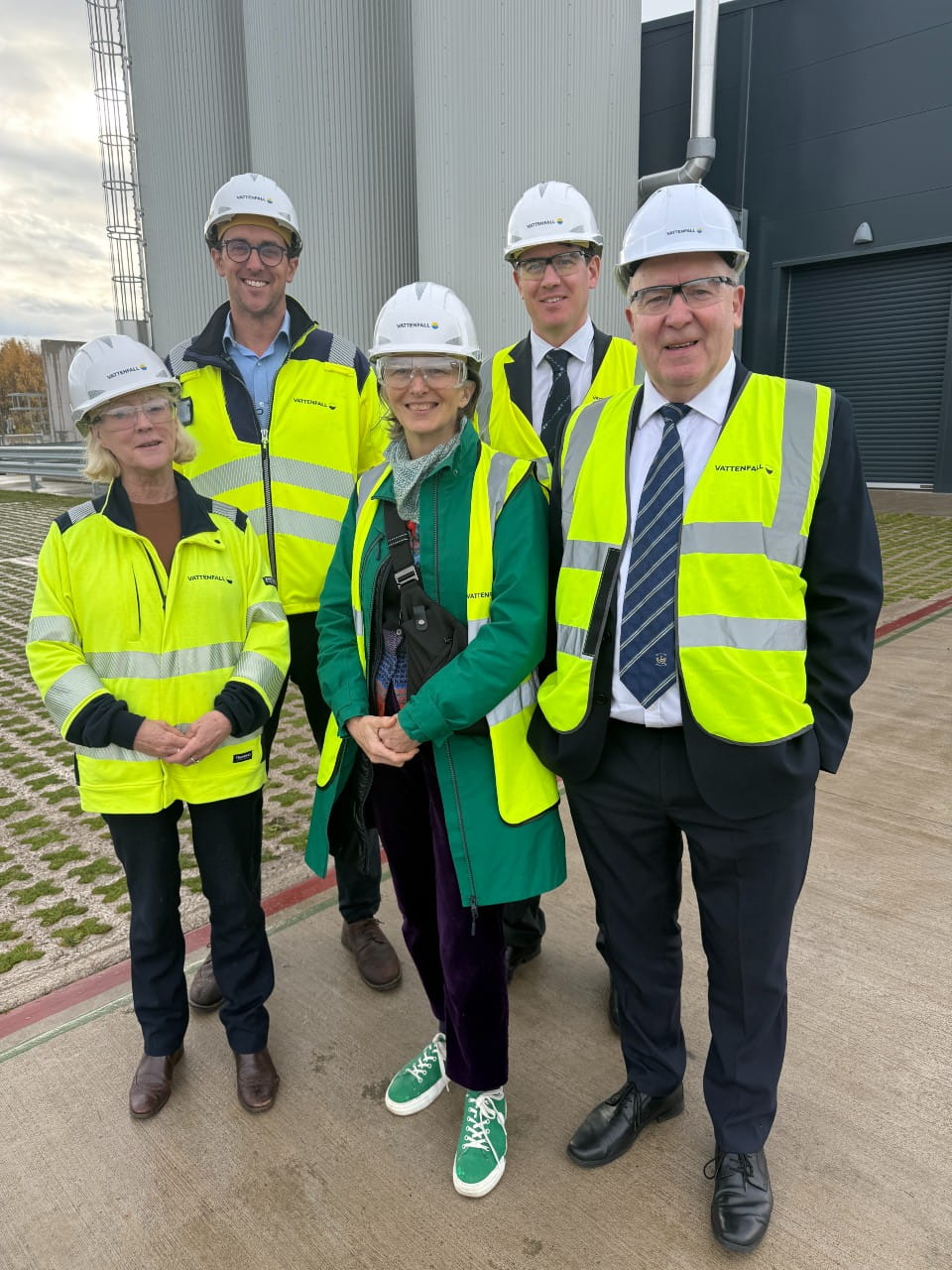
Scottish Parliament 2025
Other heat in buildings and retrofitting related work
The Committee has also considered the reform of Energy Performance Certificates this year. We took evidence from stakeholders in advance of the laying of subordinate legislation to give effect to the new system.i We considered the regulations at our meeting on 11 November 2025 and agreed to recommend approval of the instrument to the Scottish Parliament.ii We reported on 27 November 2025.iii
Conclusions - Retrofitting of housing for net zero, heat in buildings and the climate change plan
The Committee is concerned at the lack of progress on a bill on heat in buildings this year. We have tracked progress on retrofitting and heat in buildings throughout the session, and despite the need for urgent action advised by the CCC and others, there has been little demonstrable progress. We acknowledge the Scottish Government has now published draft legislation.
The Committee has begun its detailed consideration of the draft climate change plan.

Building Safety and Maintenance
In 2022, the Committee took evidence on building safety in the context of scrutinising the Building (Scotland) Amendment Regulations 2022 (SSI 2022/136). The Committee used the Regulations as the focus of its sessions, but looked at issues around building safety more broadly and the recommendations of the Ministerial Working Group for Mortgage Lending and Cladding.i
The Committee expressed concern about the lack of progress being made in the remediation of buildings and agreed to return to this issue on an annual basis to see what progress is being made by the Scottish Government in responding to the ongoing challenges presented by high-risk buildings.
The Committee also agreed in 2022 that it would consider the issue of Reinforced Autoclaved Aerated Concrete (RAAC) and damp and mould.i
Cladding
Following the Grenfell tragedy in 2017, the Scottish Government put in place a cladding remediation programme to identify and remove the dangerous cladding from high rise buildings which had caused the fire at Grenfell.
During the course of this session, the Committee has monitored progress with that programme, in addition to its scrutiny of the Housing (Cladding Remediation) (Scotland) Bill in 2023-2024, which came into force in February 2025.
Following evidence sessions on the Building (Scotland) Amendment Regulations 2022, the Committee also agreed that it would hold an annual session on building safety. We agreed to focus on areas such as:
progress with the Single Building Assessment Pilot Programme;
the response to the zero valuation of flats in blocks with potentially flammable cladding systems, stemming from the EWS1 process;
the Scottish safer buildings accord; and
the role of the building standards compliance manager.
The Committee has returned to the issue of cladding remediation throughout this year. We took evidence from the then Minister for Housing in December 2024.i
Scottish Government published the "Cladding remediation: plan of action" in March 2025.ii
Following an evidence session with the Minister for Housing in April 2025iii, the Committee agreed to request quarterly reports from the Scottish Government on its progress with the cladding remediation programme.iv
The Cabinet Secretary for Housing wrote to the Committee on 7 August 2025 to provide the Committee with an update on the Scottish Government’s “The Cladding Remediation Programme: Next Phase Plan of Action”.
In October 2025, we took evidence from the Cabinet Secretary for Housing on this and the first quarterly update received by the Committee in June 2025. The Cabinet Secretary provided a further update in November 2025.v
Single Building Assessments and the pilot programme
In June, the then Minister for Housing provide the following update on the pilot:
“The 107 buildings on the Pilot were put on a pathway to assessment, starting with pre assessment checks made by an appointed fire engineer consultant. 51 were assessed as being out of scope of the Housing (Cladding Remediation) (Scotland) Act following a review by the appointed fire engineering consultants. Of the 56 buildings within scope:
10 of the buildings have been taken on by the developer
two were identified by the fire engineers as being low risk and not requiring an SBA.
12 have had or are undergoing an SBA commissioned by Scottish Government
32 will require an SBA – these will now have the opportunity to be funded for assessment through the Single Open Call.”
Scottish Government figures, published in July 2025, show that as of 30 June 2025, three Single Building Assessments (SBA) had been completed through the pilot begun in 2021, with a further 12 underway.i All three completed SBAs identified that remedial works were required. Works had commenced for two of these but not the other.
The "Cladding Remediation Programme: Next Phase Plan of Action" referred to the “…earlier pilot programme”. The Cabinet Secretary for Housing confirmed the pilot had ended and the properties within the pilot had been subsumed into the Single Open Call launched in March 2025.ii It allows local authorities, Registered Social Landlords, and residents or their representatives to apply for a fully funded Single Building Assessment.
She said that 16 Single Building Assessments (SBAs) had been completed as of 30 September 2025. However, she also noted 478 expressions of interest had received grant support which would accelerate the completion of SBAs.ii
In an update to the Committee, the Cabinet Secretary said:
"It is expected that over the coming months a significant increase will be seen in completed SBAs as a result of the Single Open Call."iv
She also said that the information gathered through the pilot programme was "vital" as it highlighted the need for legislation and the development of the Single Building Assessment Standards.
Safer buildings accord and agreements with builders
The Scottish Government announced the creation of the Scottish Safer Building Accord on 12 May 2022, which the then Cabinet Secretary described as:
"It is my clear expectation that developers linked to buildings with problematic cladding will fund remediation where this is identified. That will ensure that when public funds are needed to be spent, we can use them to focus on buildings and works where a developer cannot be identified or no parent developer exists. "i
The Cladding Remediation Plan of Action, published 25 March 2025, stated:
“We are finalising an agreement with the larger developers on the ‘Developer Remediation Contract’, enabling them to take forward assessment and remediation on properties for which they have accepted responsibility. This follows intensive negotiations since the sharing of draft terms in September 2024, with significant progress made in agreement in principle of key terms. We are working towards final agreement as soon as is practicable.” ii
The Cladding Remediation Programme: Next Phase of Action, published on 7 August 2025, states:
“Developers who previously signed a broad in principle agreement are invited to sign the Developer Remediation Contract by a deadline of 31 October 2025. This legally commits them to assessing and remediating, in line with Scottish Government standards, all buildings over 11 metres for which they have accepted responsibility.”ii
When asked what the penalties would be for those developers failing to sign the agreement, the Cabinet Secretary said she had merely set the deadline to bookend the process and she was confident with progress.iv On 7 November, she told us:
"... four developers have been participating in negotiations regarding the Developer Remediation Contract. Commensurate with the commitments set out in the Cladding Remediation Next Phase Plan of Action, I issued a formal invitation to sign the Developer Remediation Contract to participating developers on 31 October 2025, requesting signature by 28 November. Once the contract is signed, we will receive regular updates from each developer on the progress of remediation works across all buildings under their responsibility."v
Cladding - conclusions
The Committee's previous tracker reports have expressed our disappointment at the pace of this work. Last year we stated our hope that the expedited timescales for enacting the Housing (Cladding Remediation) (Scotland) Act 2024 would "...precipitate a rapid increase in the speed of remediation."
Sadly this does not appear to be the case. While the Committee acknowledges work is being carried out, and two strategies to progress the issue have been published this year, there does not appear to be an acceleration in assessing buildings and undertaking the necessary work to make them safe. We note the Cabinet Secretary's optimism that the Single Open Call will achieve this acceleration and also hope this is the case. We are of the view that while a little progress has been made, this has not been at the rate we would have liked to see.

Reinforced Autoclaved Aerated Concrete (RAAC)
In our tracker report last year, the Committee noted its intention to continue consideration of Reinforced Autoclaved Aerated Concrete (RAAC).
We took evidence from stakeholders on RAAC as part of our work on building safety issues earlier in the year.i
We concluded the Scottish Government is in a unique position to bring together relevant actors to support RAAC remediation. We believe the Scottish Government could take action to ensure momentum on remediating RAAC in public and private buildings is maintained, including work with relevant bodies to ensure there is guidance on RAAC in domestic properties as soon as possible.
On 7 November, the Cabinet Secretary wrote to the Committee noting guidance being prepared by the Institution of Structural Engineers was expected by the end of the year.ii She noted this guidance would be make publicly available and shared among stakeholder networks.
While the Cabinet Secretary for Housing was emphatic there would be no support for homeowners for RAAC remediation,i she also said "...I have said that I will consider applications for the existing funding that we make available to councils to be used flexibly."i We note examples such as Aberdeen City Council receiving funding through the Affordable Housing Supply Programme.v
In evidence to us and subsequent correspondenceii, the Cabinet Secretary emphasised the role of the UK Government in making support available to address RAAC in residential settings.ii She also set out why she believed funding raised through the proposed Scottish Building Safety Levy could not be used for RAAC remediation.ii
The Committee believes some progress is being made on RAAC remediation. We have heard from those living in affected properties, both privately owned and rented, of how this impacts on people's lives. We do therefore call on the Scottish Government to continue to find ways in which it can support local authorities and those living in affected properties, including through continued engagement with the UK Government.

Damp and mould
The issue of damp and mould in social and private rented housing prompted considerable public concern and media interest following the death of two-year old Awaab Ishak who tragically died in 2020 as a result of a severe respiratory condition due to prolonged exposure to mould in his home. Awaab lived in a housing association home in England.
The coroner investigating the case said “this should be a defining moment for the housing sector in terms of increasing knowledge, increasing awareness and a deepening of understanding surrounding the issue of damp and mould.”
The Committee took evidence in 2023 and agreed to consider the issue on an annual basis.
Our concerns in 2023/24 were the potential impact of retrofitting on damp and mould, and the quality of the data on the prevalence of the issue.
In 2025, we were concerned to still be hearing calls for better data collection from stakeholders and called on the Scottish Government to "...lead relevant organisations in the development of a consistent standard of data collection, which would allow for comparative analysis and the efficient dissemination of best practice."i
On retrofitting, the interplay between the heating homes and damp and mould was raised again in evidence sessions. The Committee has commented above on the need for progress on areas such as energy efficiency standards for the private and social rented sectors, as well as the urgent need to decarbonise heating in buildings. This need must be balanced against the need to ensure people are healthy and safe in their homes. People must be supported to make choices about heating their homes which do not exacerbate damp and mould.
An amendment to the Housing (Scotland) Bill created the power for the Scottish Government to, by regulations, require social landlords to investigate and respond to reports of damp and mould within a certain time period. The Scottish Government has said the instrument will "laid early in 2026" and be in force by March 2026. The policy is also intended to apply to private rented sector landlords.
The Committee welcomes progress on mandating action from landlords on damp and mould this year. We look forward to considering the negative instrument early in 2026.

Building Safety Levy (Scotland) Bill
The Building Safety Levy (Scotland) Bill was introduced by Shona Robison, Cabinet Secretary for Finance and Local Government on 5 June 2025. The Bill creates the Scottish Building Safety Levy (SBSL), a tax which is to be charged in relation to a step in the building control process, and its revenues used to fund improvements to building safety in Scotland. The SBSL will be administered by Revenue Scotland.
The policy memorandum explains that the overarching policy aim of the bill is to seek a contribution from the housebuilding sector to support the Scottish Government’s Cladding Remediation Programme.
The SBSL’s policy objective mirrors “the UK’s government objective for its own Building Safety Levy (BSL), which is proposed for introduction in England in Autumn 2026”. The policy memorandum goes on to say that “the differences in building control regimes mean that the English and Scottish levies will not be analogous”.
The Finance and Public Administration (FPA) Committee considered the relevant regulations to devolve the power to raise revenue aimed at funding building safety expenditure in October 2024. As the legislation is primarily concerned with the operation of levying a tax, the FPA Committee was designated as the lead committee for consideration of the Bill.
We wrote to that Committee with a copy of the evidence heard and our conclusions from our work on building safety.
Planning issues
Fourth National Planning Framework (NPF4)
In our report last year, we noted it was too early to form any judgements on NPF4. We looked forward to the outcomes from the Scottish Government's investing in planning consultation. However, we stated that for "...NPF4 to be successful local authorities must have the capacity to deliver on it."i
The Committee continued with its annual review of the implementation of the fourth National Planning Framework this year. At evidence sessions on 3 June and 17 June at which we took evidence from planning officers, house builders, built environment professionals, architects and community organisations. We heard from the Minister for Public Finance on 24 June and wrote to him on 9 September with the conclusions from our review of the implementation of the framework 2 years on from its publication.ii
We remain concerned about the resources available to planning departments and sought updates from the Minister for Planning on initiatives to improve this.ii Having also considered regulations to increase fees payable for planning applications this year, we sought details of the assessment of the impact this would have on planning departments.ii In his response, the Minister outlined the initiatives the Scottish Government has instigated to support adequate resourcing of planning departments, while noting this is ultimately the responsibility of local government.v
Some of the expected guidance to support the implementation of NPF4 is also still not available. We also heard about issues with enforcement.ii The Minister recognised the issues surrounding interpretation but also noted the importance of flexibility in the system to account for local circumstances.v He said more detailed guidance would be available in the latest version of the Delivery Programme.v
The presentation of NPF4 and accessibility of guidance on planning in general was also raised as an issue with us and we supported the view that all current policy and comment on planning should be available in one place.ii The Minister agreed with this proposal and said:
"The latest version of the Delivery Programme will provide a comprehensive report on progress to date, and we will bring this together with our ongoing work to rationalise planning guidance, to ensure information can be more easily accessed by users of the system."v
On 25 November, the Minister wrote to the Committee on updates to planning guidance. He said all dated national planning advice had been removed.xi He also noted work to update guidance was focusing on "... areas where there are pressures or a need for action in response to our delivery priorities. For example we are close to concluding work on new updated biodiversity guidance and support for planning authorities handling applications for battery energy storage."xi
We also sought details of how NPF4 is monitored and evaluated, including whether measurable indicators will be incorporated.ii The Minister said the next Delivery Programme would contain details of monitoring and noted it would "...still take time to see the legacy of the policies in our places and communities, given development timescales."v
Local development plans and local place plans were of interest to the Committee and we agreed to seek further information on how these have been developed across the country.ii The Minister undertook to consider the issues raised by the Committee in evidence in the review of LPPs which will take place in summer 2026.v
We were concerned about the role of planning in supporting an exit from the housing emergency.ii The Minister acknowledged the role of planning and said a consultation would be published in the autumn on mechanisms to accelerate housing delivery. The results of this will build on other monitoring undertaken to ensure planning is not impeding the creation of more housing.v
The Committee considers progress is being made on the implementation of NPF4. There are issues which have recurred in scrutiny of the draft document and the annual progress reviews, such as the interactions of the policies and the resources available to planning departments to implement the framework. While we do not believe concerns on these issues have yet been assuaged, we do believe there has been progress in implementing NPF4.

Local Place Plans
The Committee is interested in the development of Local Place Plans and their influence on the next round of statutory Local Development Plans. The Committee agreed to seek further details on how local communities were developing these plans via a call for views.i Local Authorities provided an overview of the activities taking place in their area.ii
The Committee considered the results of this at its meeting on 11 November and agreed to request further research to more comprehensively analyse ongoing work on local place plans and support available for communities.i
Work in 2025 - 2026
The Committee agreed a programme of work in December 2024 and June 2025 which has occupied the Committee's time.
In addition to the strands of work noted above which we have continued, we agreed to undertake a short inquiry into Council Tax.
Council tax inquiry
In 2014, the Scottish Government and COSLA established the Commission on Local Tax Reform, which reported in December 2015, and concluded that the existing council tax framework was no longer fit for purpose and that substantial reform was needed.i In 2022, the Scottish Government and COSLA formed the Joint Working Group on Sources of Local Government Funding and Council Tax Reform, to examine potential changes to the council tax system.
In January, the Committee agreed to undertake a short inquiry into council tax reform in Scotland. This is a new theme of work for the Committee but has been included in our final tracker report of the session due to the likelihood of the issue arising in the next session.
The remit of our work covered progress by the Joint Working Group, barriers to change, the case for a revaluation of domestic properties, lessons from other jurisdictions, and the likely costs and funding options for revaluation. The Committee wrote to the Scottish Government in January, ahead of the evidence sessions, requesting an update on the Joint Working Group's progress.ii
In its response, the Scottish Government referred to a joint engagement programme to gather data and evidence to help inform discussions, with activities due to begin by late summer 2025.iii The response emphasised that the work was necessary to shape reforms that are representative of stakeholders' views, whilst reiterating that the Working Group was committed to evidence-led engagement.
The Committee held evidence sessions on 18 February, 25 February and 4 March, including the Cabinet Secretary, academics, tax specialists, local government representatives and COSLA. Across these sessions, witnesses broadly agreed that the current banding system is outdated and regressive, with no revaluation since 1991.
Several witnesses highlighted that revaluation would carry substantial cost, administrative complexity and political difficulty.iv COSLA reiterated that any reform of council tax must be developed with cross-party support across all council areas, whilst emphasising the need for fairness and robust modelling.iv
The Committee wrote to the Scottish Government in April to:
Request that the 2015 Commission's reports be made readily available;
Confirm timescales for the planned independent modelling;
Recommend revaluation early in the next Parliament, including statutory requirement for further regular revaluations;
Invite the Scottish Government to confirm its commitment to the principle of revenue neutrality in revaluation;
Set out clear plans for transitional funding;
TContinue close working with COSLA and local government;
Provide a specification to the Scottish Assessors Association to enable it to assess the likely costs of revaluation as a first step and to share this document with the Committee; and
Provide details of how discussions on how council tax could look in the future would be covered by the Fiscal Framework to be agreed between COSLA and the Scottish Government.vi
In its response, the Scottish Government set out further details of a joint engagement strategy and a programme of independent analysis from the Institute for Fiscal Studies, with the intention that findings from both these areas will inform a parliamentary debate in early 2026.vii The Government also confirmed their intention that any models of reform will be delivered on a revenue-neutral basis but said that the timing of revaluation would depend on the outcome of the engagement exercise.
On the recommendation to provide the Scottish Assessors with a specification for determining the cost of revaluation, the Cabinet Secretary said she was working with the body "...to understand the resource implications of delivering potential reforms and the feasibility of different implementation scenarios."vii
The Scottish Government published the consultation on Council Tax reform on 27 October.ix In its evidence on 28 October, COSLA welcomed this, stressing the importance of ensuring that the tax is fairer and more progressive.iv The Cabinet Secretary outlined that the Government wants changes to be revenue-neutral and will not be pursuing proposals that would lead to significant increase in any particular council area.iv
The Committee recognises that the Joint Working Group's establishment constitutes a positive step, but that progress towards meaningful reform has so far been limited. There is a broad consensus from stakeholders and witnesses that the existing council tax system is inequitable, whilst acknowledging the significant practical obstacles to implementing reform.
The engagement programme between the Scottish Government and COSLA is a welcome step. The Committee will continue to monitor the outcomes of this, as well as the research commissioned from the Institute of Fiscal Studies. The Cabinet Secretary undertook to keep the Committee abreast of progress of this research and we look forward to receiving this update. We also look forward to participating in the debate on the outcome of the research.
The Committee reiterates its recommendation that the Scottish Assessors Association be provided with a specification on which to base an assessment of likely costs of revaluation and that this be shared with the Committee.
The Committee looks forward to receiving details of the results of the current consultation and the Government’s position following that.
The Committee considered there has been some progress this year.

Conclusions
The Committee draws this report to the attention of the Scottish Parliament.
We are disappointed not to have seen more progress across the different areas we have been tracking in these progress reports. As this is the last of the Session, we note our intention to draw together the conclusions from the various strands of work, and the process of tracking these across the years, in our legacy report. This will be published in March 2026.